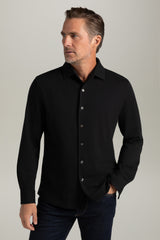
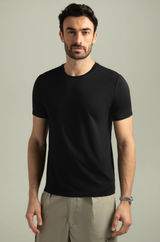
Get the plastic off your skin
Polos and tees that let the heat go.
Polyester makes you overheat, and your body answers heat with sweat. Plastic doesn't breathe: it traps heat and moisture against your skin and won't let either go. HyperNatural is built to let that heat out.
Polyester makes you overheat, and your body answers heat with sweat. Polyester is plastic. It doesn't breathe, so it traps heat and moisture against your skin, your body works harder to cool down, and the sweat it makes can't get out through the plastic to do its job. That is the hot, sticky feeling of a polyester shirt on a summer day.
Sweating is your body's thermostat. It rises with skin and core temperature, and once the air is hotter than your skin, evaporating sweat is the only way left to shed heat, according to a 2018 review by Gagnon and Crandall. Sweat only cools you when it evaporates. Sweat that sits on your skin or soaks into a shirt does nothing for you.
So a shirt that holds heat against your body adds to the load your sweat has to carry, and a shirt that holds moisture stops the sweat from carrying it.
Polyester fibers are solid plastic. Air and moisture can't pass through them, only through the gaps in the knit, so a polyester shirt holds a layer of warm, humid air against your skin. The fiber takes up almost none of your sweat (its moisture regain is about 0.4%), so the moisture stays where the heat is.
"Moisture-wicking" doesn't change the plastic. Raw polyester can't move sweat on its own, so wicking polyester relies on a chemical finish, and finishes wear off in the wash.
On a humid day, evaporation is already the bottleneck. In a 2025 study, cyclists rode at 33°C across four humidity levels. As humidity rose, the share of sweat that actually evaporated fell from 50% to 16%. The rest dripped off unused, core temperature climbed and power output dropped by about 16%.
Put a plastic shirt on top of that and the heat and the sweat both stay where they are. That is a polyester polo in August.
Heat and sweat held against your skin feed bacteria. In a 2014 Ghent University study, polyester shirts worn through a fitness class smelled stronger and worse than cotton after 28 hours, and odor-producing Micrococcus bacteria grew almost only on the synthetic. More in Why Does Polyester Smell?
Synthetic performance became the default because it was easy to make, not because it is good to wear. HyperNatural builds cooling into the fiber instead.
Jade minerals that release heat. When you touch a fabric, heat flows from your skin into the fiber, and how fast it flows decides whether it feels cool or warm. Textile labs measure it with the Qmax cool-touch test. Hyper-Cool Jade® puts jade minerals inside the fiber, not sprayed on as a finish. Like stone, jade draws heat out of whatever touches it, so the fabric pulls heat away from your skin and releases it as you move: 5° cooler with Hyper-Cool Jade®, with nothing to wash out.
A fabric that breathes. HyperNatural is 20× more breathable than polyester, so heat and moisture vapor move out of the shirt instead of building up under it. You stay comfortable and dry.
Odor control in the fiber. Hyper-Chitin, chitin from crab shells, delivers a 99%+ reduction in odor-causing bacteria with no chemical anti-odor finish. Crab shells, not chemicals.
The base is Supima® cotton, extra-long-staple American cotton made without an antimony catalyst, with Creora® Regen recycled spandex for stretch. 0% polyester, no PFAS finishes, OEKO-TEX® Standard 100 certified.
The Pinehurst jersey polo stays cool and dry through 18 holes in July. The Dagger slim-fit polo goes from a red-eye straight into a meeting. The Topanga featherweight tee goes to the gym, and you keep it on after. Get the plastic off your skin. Shop the collection.
Polyester makes you overheat, and heat is what makes you sweat. Plastic doesn't breathe, so it traps heat and moisture against your skin, your body works harder to cool down, and the sweat can't escape to cool you.
Yes. Air and moisture can't pass through the plastic fiber, so a polyester shirt holds a layer of warm, humid air against your body all day.
Because it traps heat and moisture together. The fiber takes up almost none of your sweat, so warm, damp air builds up between the shirt and your skin. "Moisture-wicking" polyester depends on a chemical finish that wears off in the wash.
A breathable natural fiber with cooling built in. HyperNatural's Hyper-Cool Jade® draws heat away from your skin for 5° cooler, and the fabric is 20× more breathable than polyester, so heat and moisture can escape.
This article is for general information and is not medical advice.
Built for the hottest days
Cooling built into the fiber, not sprayed on.
In the heat
What HyperNatural feels like when the day gets hot, from verified buyers.
When you put it on it has this soft cool touch. Fabric breaths very well, so I don't get hot and sticky.

On the course
If you naturally run hot it's a game changer.

Hot, muggy travel
I took two polos with me to my trip to St. Lucia and they kept me soooo cool and dry even in hot muggy climates!

Every hot day
Perfect for Hot days
Polyester makes you overheat, and heat is what makes you sweat. Plastic doesn't breathe, so it traps heat and moisture against your skin, your body works harder to cool down, and the sweat can't escape to cool you.
Yes. Air and moisture can't pass through the plastic fiber, so a polyester shirt holds a layer of warm, humid air against your body all day.
Because it traps heat and moisture together. The fiber takes up almost none of your sweat, so warm, damp air builds up between the shirt and your skin. "Moisture-wicking" polyester depends on a chemical finish that wears off in the wash.
A breathable natural fiber with cooling built in. HyperNatural's Hyper-Cool Jade® draws heat away from your skin for 5° cooler, and the fabric is 20× more breathable than polyester, so heat and moisture can escape.

"Why don't we think more about what is directly against our skin?"
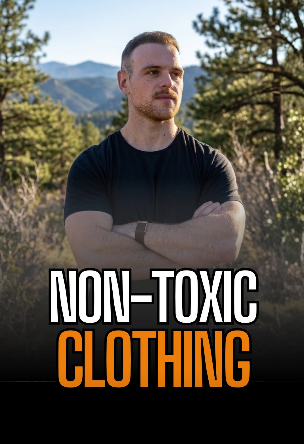
"Naturally antimicrobial. Naturally anti-inflammatory. 99.9% odor resistant. Zero BPA. Zero PFAS."

"I'm all about non-toxic fits and this brand gives me tons of options with real natural materials."

"This is for the man in your life. To nudge them in the right direction."

"No overheating, no odor and looking classy"

"They take it to a whole new level. Hypernatural is making fabric out of crab shells."
"The comfort and freedom of movement that I get with these clothes is absolutely awesome"

"I really like this. It's super soft and breathable."


Polos and tees that let the heat go.