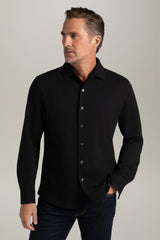
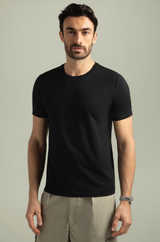
Stop wearing the shirt that keeps the smell
Bio-performance fabric built from Supima® cotton, jade minerals and chitin. 99%+ reduction in odor-causing bacteria, 0% polyester, OEKO-TEX® Standard 100 certified.
Polyester smells because the fiber hoards the oily compounds in sweat and then hosts the bacteria that turn them into odor. Two decades of textile research explain it — and why the smell survives the wash.
Polyester smells because two things happen at once. The fiber is oleophilic — it attracts the oily, non-polar compounds in sweat and sebum that carry odor, and holds on to them. And its surface favors a particular group of skin bacteria, Micrococcus, that break sweat down into the volatile molecules you actually smell. Cotton does neither to the same degree, which is why a cotton shirt and a polyester shirt worn through the same workout smell so different the next morning.
Both halves of that answer come from peer-reviewed research: a 2024 University of Alberta study on how fibers absorb and release odorants, and a 2014 Ghent University study on which bacteria grow on which fabric. The same research explains why the smell survives laundering and why "anti-odor" silver finishes often disappoint.
Sweat leaving the gland is close to odorless. Apocrine glands secrete long-chain fatty acids and odorless precursors too large to evaporate; skin bacteria — mainly Staphylococcus and Corynebacterium species — cut them into small, volatile compounds, and those are what you smell. No bacteria, no smell.
Clothing is a second habitat: a shirt takes up sweat, sebum and bacteria, then sits in a gym bag for hours while they keep metabolizing. Which bacteria thrive, and which odorants the fabric holds, depends on the fiber.
In 2024 Rachel McQueen at the University of Alberta, with Graham Eyres and Raechel Laing at the University of Otago, published a study in the Textile Research Journal that separated the fiber from the bacteria. They immersed bundles of six fibers — cotton, mercerized cotton, viscose, wool, nylon 6.6 and polyester — in a synthetic sweat solution at pH 4.3 spiked with nine odorants (ketones, aldehydes, carboxylic acids), then measured what each fiber released into the air above it at 30 minutes, 3 hours and 24 hours by proton-transfer-reaction mass spectrometry.
The results split along a chemical line. The cellulosic fibers — cotton, mercerized cotton and viscose — released markedly lower intensities of ketones and aldehydes than wool, nylon or polyester at 30 minutes. Nylon released the most early and aired out quickly; wool likewise absorbed and released fast. Polyester kept releasing, and by 24 hours was giving off higher intensities of those compounds than any other fiber.
The explanation is water. Cellulose has a strong affinity for liquid water, so cotton and viscose take up water and exclude the larger, less polar odor compounds. Polyester has almost no affinity for water, and neither do the non-polar ketones and aldehydes; that shared lack of affinity, the authors write, is why those odorants adsorb to the polyester surface. Their conclusion: cellulosic clothing may tend to be less odorous than synthetic garments when worn, and nylon and wool air out more effectively than polyester. Crucially, no bacteria were involved: polyester held more odor with nothing alive on it.
Ten years earlier, Chris Callewaert and colleagues at Ghent University ran the wear test, published in Applied and Environmental Microbiology. Twenty-six healthy people did an intensive spinning session in a cotton or polyester T-shirt; the shirts were incubated for 28 hours, evaluated by a trained odor panel, and their bacterial communities profiled by DNA fingerprinting.
The panel rated the polyester shirts significantly less pleasant and more intense than the cotton, across five odor descriptors. Micrococcus species were isolated from almost all synthetic shirts and detected almost exclusively on synthetics; an in-vitro growth experiment confirmed polyester selectively enriches them. Staphylococcus was abundant on both fabrics; Corynebacterium, the main odor producer on skin, was not enriched on either. Micrococci break fatty acids, hormones and sulfur compounds into small volatile molecules with, in the authors' words, a typical malodor. Put the two studies together: polyester soaks up the oily raw material, then hosts the bacteria best equipped to turn it into smell.
The most common form of this question is why polyester still smells after washing, and the answer follows from the same chemistry. A wash removes mostly water-soluble soil. Sebum and the non-polar odorants bound to a hydrophobic fiber are not water-soluble, and detergent penetrates cotton more readily than polyester.
McQueen's group tested this in a 2020 Textile Research Journal study that soiled cotton and polyester with model odorants through repeated soil-and-wash cycles. Both fabrics retained and re-emitted odorants after laundering, but polyester retained and released more; laundering removed odorants from cotton more effectively; and the polar odorant tested, octanoic acid, washed out of both fabrics more readily than the two non-polar odorants. Non-polar compounds on a non-polar fiber are the ones that survive.
A 2020 review in Microorganisms by Van Herreweghen, Amberg, Marques and Callewaert reaches the same conclusion from the laundry side: polyester's hydrophobic nature produces strong adherence of fatty acids and aromatic compounds, some sebum components are difficult to remove by washing especially from polyester, and polyester generally shows higher malodor intensities than cotton or wool. The review adds that wash temperatures of 50°C and above achieve sufficient bacterial removal, while cool washes with enzyme detergents often do not — so a resident population builds up from one wash to the next.
Earlier Alberta wear studies add the time dimension. In a 2007 study of nine knit fabrics worn against the armpit, odor intensity was strongly tied to fiber — polyester high, cotton and wool mid to low — and inversely related to how hygroscopic the fiber was. In the group's follow-up, compounds consistent with short-chain carboxylic acids increased above polyester after seven days of storage but not above cotton or wool. That is the shirt that smells fine out of the dryer and terrible ten minutes into wearing it: body heat releases what the wash left behind.
| Fiber | Water affinity | What the research shows |
|---|---|---|
| Polyester | Very low (hydrophobic, oleophilic) | Absorbs the most non-polar odorants, releases them slowest, selectively enriches Micrococcus; most intense in wear trials. |
| Nylon | Low to moderate | Absorbs readily but airs out fast. In a 2018 wear trial with eight wearers and 13 assessors, no difference in odor intensity from polyester. |
| Wool | High | Absorbs then releases quickly; mid to low intensity in wear trials. |
| Cotton and viscose | High (cellulosic) | Take up water and exclude oily odorants; lowest ketone and aldehyde release; launder clean more effectively. |
The industry's answer has been to kill the bacteria with an antimicrobial finish — silver, zinc pyrithione, triclosan — applied to the polyester. On an agar plate these finishes work. On a body, the record is weaker.
In 2014 McQueen's group published two experiments in the International Journal of Clothing Science and Technology. In the first, textiles finished with triclosan, a zinc pyrithione derivative and a silver chloride–titanium dioxide compound were antimicrobial in vitro but performed very differently on skin, with the silver–titanium compound hardly eliminating any bacteria. In the second, eight men wore polyester treated with a bioactive concentration of silver chloride against untreated polyester. In wear, the treated fabric did not perceptibly lower odor intensity or bacterial counts. McQueen's explanation was that sweat and skin proteins interfere with the finish; her summary is the line to remember: reducing bacteria on a textile may not eliminate or reduce odor noticeably.
The 2024 sorption study shows why a bacteria-only strategy is incomplete: polyester held odorants with no bacteria present at all, and a finish that kills microbes does nothing about odorants already bound to the fiber. Nor does the finish stay put. A 2008 study in Environmental Science & Technology by Benn and Westerhoff washed six brands of silver-treated socks and found silver leaching into the wash water — from under 1% to nearly all of the silver present, depending on the brand.
This is where HyperNatural's approach differs, and Hyper-Chitin is the least familiar of our materials, so it deserves a proper explanation.
Chitin is the structural polysaccharide of crustacean shells, the second most abundant natural polymer after cellulose. Ours comes from crab shells, a byproduct of the seafood industry. Its deacetylated form, chitosan, is among the most studied natural antimicrobials in the biomedical literature, and the mechanism is well characterized.
Chitosan carries amino groups along its backbone. In a mildly acidic environment — sweat and the skin surface are mildly acidic — those groups protonate and carry a positive charge, while bacterial cell surfaces are negatively charged. A 2023 review in Materials describes the primary mechanism as the positively charged chitosan polycation interacting with negatively charged segments of the microbial cell surface, causing a significant alteration in membrane permeability and leakage of intracellular content. A 2020 review of chitosan-based antibacterial systems adds two secondary routes: chelation of trace metals bacteria need, and small fragments crossing the cell wall to interfere with DNA replication. Activity rises with the degree of deacetylation and is strongest below chitosan's pKa of about 6.3 to 6.5 — the pH range of a sweaty shirt.
The differences from a silver finish are structural. Chitin is incorporated at the yarn level, not applied as a coating, so there is nothing to wash out. It is a natural polymer rather than a heavy metal or synthetic biocide, compatible with OEKO-TEX® Standard 100 certification. And it is paired with a cellulosic base, Supima® cotton, which per the 2024 Alberta study absorbs fewer oily odorants in the first place. Two mechanisms in one fabric: less raw material for bacteria, and an environment they do not thrive in. In testing, HyperNatural fabrics with Hyper-Chitin show a 99%+ reduction in odor-causing bacteria. We do not claim a shirt that never needs washing; we claim one that does not become the polyester shirt in the Ghent study.
Because washing removes water-soluble soil, and the compounds that make polyester smell are not water-soluble. Polyester is hydrophobic and oleophilic, so sebum and non-polar odorants bind to the fiber and resist detergent; a 2020 University of Alberta study found laundering removed odorants from cotton more effectively than from polyester. Cool washes also leave bacteria behind — a 2020 review puts sufficient bacterial removal at 50°C and above. Body heat then releases what the wash left in the fiber.
Yes. In a 2014 Ghent University trial, 26 people exercised in cotton or polyester shirts; after 28 hours a trained panel rated the polyester significantly more intense and less pleasant, and odor-producing Micrococcus bacteria were found almost solely on the synthetic shirts. A 2024 University of Alberta study showed the fiber itself is part of the cause: polyester absorbed more oily odorants from a sweat solution than cotton or viscose and was still releasing them at 24 hours, with no bacteria involved.
In wear trials, about the same. Nylon airs out faster than polyester in lab tests, which is why it is sold as the fresher synthetic, but a 2018 study in which eight people wore nylon and polyester underarm panels, rated by 13 assessors, found no difference in odor intensity between the two fibers. Differences depended on the wearer, not the fabric.
Less than the packaging suggests. In a 2014 University of Alberta wear trial, eight men wore silver-chloride-treated and untreated polyester, and the treated fabric produced no perceptible reduction in odor or bacterial counts despite antimicrobial activity in the lab. Sweat and skin proteins interfere with the finish, and killing bacteria does nothing about the oily odorants already bound to the fiber. A 2008 study also found silver-treated socks leaching from under 1% to nearly all of their silver into wash water.
Fibers that absorb water rather than oil. Cotton and viscose released the least odorant in the 2024 University of Alberta study, wool absorbs and releases quickly, and polyester was worst on both counts while also selecting for odor-producing bacteria. The strongest option pairs a cellulosic base with an antimicrobial that is part of the fiber rather than a coating. HyperNatural fabrics combine Supima® cotton with Hyper-Chitin, a natural antimicrobial from crab-shell chitin, and show a 99%+ reduction in odor-causing bacteria in testing.
Last reviewed September 2026. HyperNatural makes apparel from bio-based fibers rather than petroleum-based synthetics, so we have a commercial interest in this subject — which is why every claim above is sourced, including the ones about our own material.
Performance without Polyester
Chitin, from crab shells, is part of the yarn use to make HyperNatural shirts. It creates a 99%+ reduction in odor-causing bacteria.

Where the odor chemistry actually differs.
Absorbs less odorant
Cellulosic Supima® cotton takes up water and excludes oily odorants
Hoards oily odorants
Oleophilic polyester binds sebum and non-polar compounds
Chitin in the yarn
Natural antimicrobial engineered into the fiber — nothing to wash out
Silver sprayed on top
Finish that leaches in the wash and failed to cut odor in wear trials
Launders clean
Cellulose lets detergent reach and lift what was absorbed
Smell survives the wash
Non-polar residue stays bound and re-emerges with body heat
99%+ fewer odor bacteria
Hyper-Chitin disrupts bacterial cell membranes on contact
Grows Micrococcus
Polyester selectively enriches odor-producing micrococci
Polyester is an oil-loving fiber that keeps feeding bacteria that create the synthetic funk.
Because washing removes water-soluble soil, and the compounds that make polyester smell are not water-soluble. Polyester is hydrophobic and oleophilic, so sebum and non-polar odorants bind to the fiber and resist detergent; a 2020 University of Alberta study found laundering removed odorants from cotton more effectively than from polyester. Cool washes also leave bacteria behind — a 2020 review puts sufficient bacterial removal at 50°C and above. Body heat then releases what the wash left in the fiber.
Yes. In a 2014 Ghent University trial, 26 people exercised in cotton or polyester shirts; after 28 hours a trained panel rated the polyester significantly more intense and less pleasant, and odor-producing Micrococcus bacteria were found almost solely on the synthetic shirts. A 2024 University of Alberta study showed the fiber itself is part of the cause: polyester absorbed more oily odorants from a sweat solution than cotton or viscose and was still releasing them at 24 hours, with no bacteria involved.
In wear trials, about the same. Nylon airs out faster than polyester in lab tests, which is why it is sold as the fresher synthetic, but a 2018 study in which eight people wore nylon and polyester underarm panels, rated by 13 assessors, found no difference in odor intensity between the two fibers. Differences depended on the wearer, not the fabric.
Less than the packaging suggests. In a 2014 University of Alberta wear trial, eight men wore silver-chloride-treated and untreated polyester, and the treated fabric produced no perceptible reduction in odor or bacterial counts despite antimicrobial activity in the lab. Sweat and skin proteins interfere with the finish, and killing bacteria does nothing about the oily odorants already bound to the fiber. A 2008 study also found silver-treated socks leaching from under 1% to nearly all of their silver into wash water.
Fibers that absorb water rather than oil. Cotton and viscose released the least odorant in the 2024 University of Alberta study, wool absorbs and releases quickly, and polyester was worst on both counts while also selecting for odor-producing bacteria. The strongest option pairs a cellulosic base with an antimicrobial that is part of the fiber rather than a coating. HyperNatural fabrics combine Supima® cotton with Hyper-Chitin, a natural antimicrobial from crab-shell chitin, and show a 99%+ reduction in odor-causing bacteria in testing.

"Why don't we think more about what is directly against our skin?"
"Naturally antimicrobial. Naturally anti-inflammatory. 99.9% odor resistant. Zero BPA. Zero PFAS."

"I'm all about non-toxic fits and this brand gives me tons of options with real natural materials."

"This is for the man in your life. To nudge them in the right direction."

"No overheating, no odor and looking classy"

"They take it to a whole new level. Hypernatural is making fabric out of crab shells."
"The comfort and freedom of movement that I get with these clothes is absolutely awesome"

"I really like this. It's super soft and breathable."


Bio-performance fabric built from Supima® cotton, jade minerals and chitin. 99%+ reduction in odor-causing bacteria, 0% polyester, OEKO-TEX® Standard 100 certified.