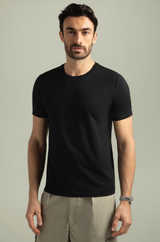
Replace the first layer first
The tee and polos that spend the most hours against your skin. Supima® cotton with Hyper-Cool Jade®, 0% polyester.
You read the label on your food, your skincare and your cookware. Then you spend all day in plastic. Your closet belongs in your low-tox routine.
You read the ingredients in your food.
You check what is inside your supplements, skincare, cookware and cleaning products.
But have you ever asked what is inside the clothing pressed against your skin for eight, twelve or even twenty-four hours a day?
Truth: your wellness routine does not stop at your closet door.
Most modern performance clothing is made from polyester, nylon, acrylic or elastane—petroleum-derived synthetic materials commonly understood as forms of plastic. These fabrics may also involve dyes, chemical finishes, odor treatments, water repellents and other additives that are rarely disclosed on a clothing label. (HyperNatural)
That matters because your clothing is not sitting passively on a hanger. It is touching, stretching and rubbing against your body while you work, travel, exercise, sweat and sleep.
It may be time to listen to your skin.
Calling skin “porous” can oversimplify the science. Your skin is designed to protect you, and it blocks many substances effectively. But it is not completely impermeable.
Researchers evaluate dermal exposure precisely because certain substances can enter or remain within skin tissue. A 2024 study using three-dimensional human skin models found measurable dermal absorption of several PFAS compounds. Some shorter-chain PFAS showed particularly substantial absorption under the study’s laboratory conditions. (ScienceDirect)
This does not prove that wearing a polyester shirt causes disease. That would be an irresponsible leap.
It does show why the substances placed against our skin—and the conditions under which we wear them—deserve more serious attention.
Workout clothing creates a specific combination of conditions:
Heat. Sweat. Skin oils. Friction. Prolonged contact.
University of Birmingham researchers found that synthetic sweat could leach flame-retardant chemicals from microplastic particles, making those substances potentially available for absorption through skin. The researchers also reported that sebum-like oily components in sweat helped facilitate this chemical migration. This was laboratory research, not a clinical trial of people wearing activewear, but it identified a plausible exposure pathway that deserves further investigation. (University of Birmingham)
That distinction matters.
The science does not currently prove that polyester activewear directly causes cancer, infertility, hormonal disorders or autoimmune disease. Long-term human research specifically connecting apparel use to those outcomes remains limited.
But the absence of complete long-term evidence is not the same as proof of zero exposure.
For low-tox consumers, the practical question becomes:
Why accept unnecessary plastic and chemical contact when cleaner alternatives are available?
Dr. Taylor Bullock is a Cleveland Clinic dermatologist who completed his dermatology residency at Cleveland Clinic and earned his medical degree through the Cleveland Clinic Lerner College of Medicine at Case Western Reserve University. His clinical work focuses on adult dermatology. (Cleveland Clinic)
Dr. Bullock has also publicly partnered with HyperNatural to discuss the relationship between clothing, prolonged skin contact and the growing consumer concern surrounding plastic-based performance apparel. His social content identifies the relationship as a HyperNatural partnership, an important disclosure when evaluating any expert collaboration. (Instagram)
The broader point is not that one shirt determines your health.
It is that clothing deserves a place in the same conversation as clean skincare, non-toxic cookware, filtered water and ingredient-conscious personal care.
Your skin interacts with what you wear every day. That makes apparel a legitimate part of a modern wellness strategy.
Low-tox living is not about panic or perfection. It is about reducing avoidable exposures where practical.
Start with the clothing that experiences the most direct contact, heat and moisture:
Underwear and base layers
Workout and fitness shirts
Sleepwear
Travel clothing
Everyday tees and polos
A jacket worn over several layers may represent a very different contact profile than a synthetic workout shirt rubbing against sweaty skin during a ninety-minute training session.
Replace the first layer first.
That is where wearable wellness begins.
“Natural,” “sustainable,” “eco-friendly” and “non-toxic” are often used loosely. Better clothing claims should be specific, testable and easy to verify.
Look for apparel that provides clear answers to these questions:
Is the fabric made from plastic-based synthetic fibers?
Polyester may be recycled, moisture-wicking or performance-treated, but it remains a synthetic polymer.
Are PFAS or other chemical finishes intentionally added?
Water resistance, stain resistance and oil repellency have historically been common applications for PFAS chemistry.
Has the material been independently tested?
Third-party laboratory reports are more meaningful than unsupported marketing language.
Does the certification cover the actual textile?
The certificate should state its scope, product class and expiration date.
Does the company distinguish textile performance from medical outcomes?
A cooling fabric can be tested for cool-touch performance without claiming that it lowers core body temperature or treats a health condition.
Clean apparel should be built on proof—not fear.
HyperNatural was created as a cleaner alternative to traditional synthetic performance apparel.
Its bio-based performance textiles combine premium cotton with mineral-infused viscose made using jade stone and chitin-derived material. The goal is to deliver cooling, breathability and odor resistance without building the garment around polyester plastic or chemical cooling finishes. (HyperNatural)
HyperNatural states that its materials are made without intentionally added:
PFAS, BPA, BPS, PFCs and phthalates. (HyperNatural)
The current OEKO-TEX® STANDARD 100 certificate covers specified knitted cotton-and-viscose fabrics in white and reactive-dyed black. The fabric received Product Class I certification, the class used for baby articles and subject to the strictest OEKO-TEX testing requirements. The certificate is valid through April 30, 2027.
OEKO-TEX reports that STANDARD 100 testing evaluates textiles against more than 1,000 harmful substances, with stricter requirements applied as expected skin contact becomes more intensive. (OEKO-TEX)
That is what “certified clean” should mean: a defined standard, a documented scope and independent verification.
Low-tox clothing should not force you to choose between wellness and function.
Hyper-Cool Jade® fabric recorded a Qmax result of 0.13 W/cm² in SGS testing. Qmax measures the rapid movement of heat when fabric first contacts a warmer surface—the physical sensation commonly described as cool-to-the-touch. It does not prove a reduction in core body temperature. (Shopify)
Separate SGS testing under AATCC TM100 found greater than 99.99% reduction after 24 hours for the two bacteria tested: Staphylococcus aureus and Klebsiella pneumoniae. This validates antibacterial activity on the tested textile; it does not mean the garment prevents infection or treats a skin condition. (Shopify)
That is the real promise of bio-based performance:
Cooling you can measure. Odor control you can test. Ingredients you can understand.
You may spend an hour exercising, eight hours working and another eight hours sleeping.
Throughout most of that time, something is touching your skin.
A true wellness lifestyle should consider not only what goes into your body, but also what surrounds it:
The air you breathe.
The water you drink.
The products you apply.
The surfaces you cook on.
And the clothing you wear.
This is not about claiming that every synthetic garment is toxic.
It is about refusing to accept plastic as the automatic definition of performance.
When your clothing traps heat, holds odor, feels slick when wet or irritates your skin, your body may be telling you that the material is not working with you.
Listen.
Ask what the garment is made from. Ask how its performance was created. Ask whether the fabric has been independently tested. Ask which chemicals were intentionally excluded.
Because better performance should not require more plastic.
The next frontier of better-for-you is your closet.
HyperNatural is building it with cotton, jade stone and chitin—clean bio-performance materials designed to work with your body, not against it.
Yes. Polyester is a petroleum-derived synthetic polymer. Recycled polyester reduces demand for some virgin material, but it remains plastic-based and can still shed synthetic microfibers. (HyperNatural)
Certain chemicals can penetrate or remain within skin under laboratory conditions. Research has demonstrated dermal uptake for some PFAS and chemical migration from microplastics into synthetic sweat. The degree of exposure from ordinary clothing use and its long-term health implications still require more human research. (University of Birmingham)
Current evidence does not support making a direct claim that wearing polyester causes a specific disease. The defensible concern is that synthetic textiles can create potential exposure to plastic fibers, additives and textile finishes, especially during prolonged heat, sweat and friction. (HyperNatural)
It means the certified textile has passed testing against defined harmful-substance criteria. Requirements become stricter for products intended for more intensive skin contact. It does not mean that a product is literally “chemical-free” or medically certified. (OEKO-TEX)
Begin with products worn directly against the skin for long periods: underwear, workout shirts, base layers, sleepwear and everyday tees. This prioritizes the garments exposed to the most heat, sweat and friction. (HyperNatural)
Start with what touches your skin
Featherweight tees and polos in Supima® cotton with Hyper-Cool Jade®. No polyester.
Why don't we think more about what is directly against our skin?
Dr. Taylor Bullock, MD, Dermatologist
Better performance should not require more plastic.
The tee and polos that spend the most hours against your skin. Supima® cotton with Hyper-Cool Jade®, 0% polyester.

"Why don't we think more about what is directly against our skin?"
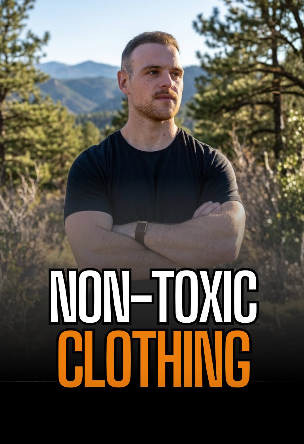
"Naturally antimicrobial. Naturally anti-inflammatory. 99.9% odor resistant. Zero BPA. Zero PFAS."

"I really like this. It's super soft and breathable."

"They take it to a whole new level. Hypernatural is making fabric out of crab shells."

"I'm all about non-toxic fits and this brand gives me tons of options with real natural materials."
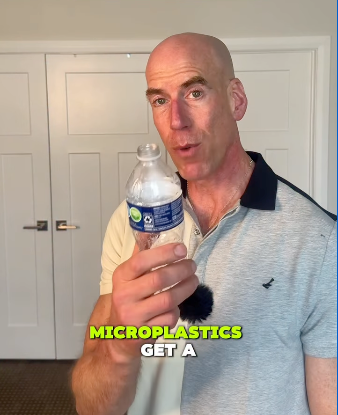
"The comfort and freedom of movement that I get with these clothes is absolutely awesome"

"No overheating, no odor and looking classy"

"This is for the man in your life. To nudge them in the right direction."


Supima® cotton, jade and crab shells. 20× more breathable than polyester, 5° cooler with Hyper-Cool Jade®, Certified Non-toxic.