The short answer
Polyester is the wrong fiber for a golf shirt. It is plastic. It holds heat, it holds odor and it sheds microfibers into the wash and the air around you. It is on the rack because it is cheap to make and easy to print, not because it is good to wear for four hours.
The good news is that you are not stuck choosing between cotton and polyester golf shirts. Everything you want can be engineered into a natural fiber without the plastic, and that is HyperNatural's third path: performance materials made better by nature,
Why most of these guides are rigged
Search "cotton vs polyester golf shirt" and nearly every result is a short post from a brand that sells polyester polos. They reach the same verdict and rarely cite anything. A comparison written by the side that sells plastic is not a comparison.
The comparison at a glance
Cotton, polyester, and HyperNatural's third path:
| Category |
Cotton |
Polyester |
HyperNatural |
| Moisture handling |
Absorbs sweat into the fiber (standard regain ~8.5%) |
Absorbs almost nothing (~0.4%); sweat sits on the plastic surface until it evaporates |
Supima® absorbs and evaporates; the light micro-pique or featherweight jersey knit keeps it off the skin |
| Drying time |
Slower in a heavy knit; holds more water per gram |
Dries fastest on the rack, mostly a thickness effect; you are not wearing it on the rack |
Light Supima® knit closes most of the gap on the body, with no plastic on your skin |
| Breathability |
Fiber is hydrophilic and vapor-permeable; knit does the rest |
Fiber is hydrophobic and vapor-tight; breathes only through holes in the knit |
20× more breathable than polyester |
| Heat and feel on skin |
Cool to the touch; wet cotton clings |
Warm and slick when saturated; no thermoregulation edge in controlled tests |
5° cooler on skin with Hyper-Cool Jade®; jade minerals in the fiber conduct heat away |
| Odor after a round |
Absorbs and releases fewer odor compounds |
Holds odor compounds longest; hosts odor-producing micrococci |
99%+ reduction in odor-causing bacteria from Hyper-Chitin, a natural antimicrobial |
| UV protection |
Plain white tee UPF ~7, ~3 when wet |
Most polyester fabrics test UPF 30+; sunscreen beats it |
Set by colour and knit density. |
| Durability |
Good; short-staple cotton pills and fades |
Abrasion-resistant and colourfast, the same property that means it never biodegrades |
Supima® extra-long staple, about twice as strong as regular cotton |
| Wrinkles |
Wrinkles unless blended or treated |
Does not crease, because it is plastic |
Pique knit with Creora® Regen recycled spandex recovers; no resin finish |
| Environment and health |
Natural fiber, no microplastics; conventional farming has a footprint |
Fossil-derived plastic; sheds microfibers in wash and wear; disperse dyes are contact allergens |
OEKO-TEX® Standard 100; bluesign® |
| Price |
Higher raw-fiber cost |
Cheapest fiber to make, dye and print; the brand's margin, not your benefit |
Premium; the cost of the fiber, not of a finish that washes out |
Round by round
Moisture handling
This is the round the polyester guides are built on, so be precise about "wicking." Polyester does not absorb sweat. Its standard regain is 0.4%; the fiber is plastic, so sweat moves along the outside of the fibers by capillary action and evaporates from the surface. That is wicking: the sweat is still on you until it leaves. Cotton is hydrophilic: under standard conditions it holds about 8.5% of its weight in water inside the fiber, and far more when you sweat.
Absorbing sweat is not a defect. It is what a towel does, and at a moderate sweat rate a cotton knit pulls moisture off your skin and evaporates it. Cotton's failure is saturation: a soaked cotton shirt gets heavy and stays wet, and polyester never fills up because it never took anything in. In a controlled exercise study at 30°C, Gavin and colleagues found no difference in core temperature, physiological strain or comfort between cotton and a wicking polyester. Wicking moves sweat around; it does not cool you.
HyperNatural keeps the absorbency and fixes the saturation. The Supima® base takes sweat into the fiber the way cotton should, and the knit is built light and open, a micro-pique in the Dagger, a featherweight jersey in the Pinehurst, so there is less fabric to fill and more surface to evaporate from. Moisture leaves the skin, spreads and dries instead of pooling, and nothing in the shirt is plastic.
Drying time
A 2025 study from Empa, the Swiss materials lab, ran cotton and polyester fabrics through four drying protocols, including one-sided drying on a heated plate simulating skin. Fabric thickness affected drying more than fiber type did, and contact with skin-temperature heat sped drying up 2.5 to 11 times. The drying gap you were sold is mostly a thickness gap: a thin knit on a warm back dries fast whatever it is made of, and a thick polyester dries slowly.
HyperNatural pulls the lever the study points at, which is thickness. A featherweight Supima® jersey or a light micro-pique is thin, and it sits against a warm back.
Breathability
"Breathable" means two different things: air moving through the fabric, and water vapor moving through it. Air permeability is almost entirely knit construction and a polyester and a cotton knitted to the same spec pass similar air. Vapor is where polyester fails. Cellulose absorbs and passes water vapor through its structure; polyester is vapor-tight, so it vents only through the gaps in the knit. A polyester shirt is breathable the way a plastic bag with holes in it is breathable.
This is the property HyperNatural's Hyper-Cool Jade® fabric is built on. The fiber is cellulose, so vapor moves through it as well as around it, and the knit is open on top of that. The result tests 20× more breathable than polyester, because the fiber contributes and not just the holes. On a humid afternoon that is the difference between a shirt that vents and a shirt that steams.
Heat and how it feels on skin
Two things get lumped together here. The first is "cool touch," how fast a fabric pulls heat from your skin on contact, measured in labs as thermal absorptivity. Cellulose fibers such as cotton and viscose have a well-documented cool hand. Polyester feels warmer and slicker by comparison. The second is whether the shirt changes your body temperature, and on the evidence polyester does not: the Gavin study found no thermoregulatory difference at moderate heat. The "cooling" polyester polo is a warm fiber with a marketing budget.
Hyper-Cool Jade® takes the cool touch cellulose already has and pushes it further. Jade minerals are embedded in the fiber itself, not sprayed on, and they conduct heat away from the skin, which is where the 5° cooler comes from. Put a Pinehurst on at the first tee on a hot day and the fabric is cool where it touches you; polyester feels like what it is, a warm sheet of plastic.
Odor after a round
Polyester stinks, and there are two independent lines of evidence for why. In 2014, Callewaert and colleagues collected T-shirts from 26 people after a spinning session, incubated them for 28 hours and had a trained panel smell them. Polyester smelled significantly more intense and less pleasant than cotton. The culprit was Micrococcus, an odor-producing bacterium found almost exclusively on the synthetic shirts.
In 2024, Rachel McQueen's group at the University of Alberta soaked cotton, viscose, wool, nylon and polyester fibers in synthetic sweat carrying known odor compounds and tracking what each released over 24 hours by mass spectrometry. Polyester absorbed and released the most and held its odor intensity longest. Cotton and viscose absorbed and released the least. McQueen's explanation: polyester does not absorb the water in sweat, it absorbs the oily compounds, which then break down and smell.
UV protection
Gambichler and colleagues measured 236 summer fabrics and found that weave density, colour and weight matter as much as fiber, so a dark, tight cotton pique does far better than a thin white tee. UPF is the one number polyester's marketing has, and sunscreen beats it.
A HyperNatural polo UPF is set by colour and knit density, so a dark micro-pique does better than a white featherweight jersey.
Durability
Polyester's abrasion resistance and colourfastness, which Golf Digest's fabric explainer notes, are the same property that keeps it from ever biodegrading.
HyperNatural uses Supima® Cotton that is an extra-long-staple cotton grown in the American Southwest that is twice as strong as regular cotton; longer fibers anchor more securely in the yarn, so Supima® knits pill and tear less than commodity cotton. It is the base fiber in every HyperNatural golf polo for exactly this reason. A well-made Supima® polo outlasts a cheap polyester one and biodegrades when you are finished with it. A polyester polo only outlasts everything, in a landfill.
Wrinkles and care
Cotton wrinkles because its cellulose chains are held together by hydrogen bonds that break and re-form in new positions when the fabric is bent while damp. Polyester's chains do not do this, so it comes out of a suitcase looking pressed and smelling of the last round. Cotton's answers are a blend, a knit with some stretch, or a chemical crosslinking finish; that last one is where formaldehyde-releasing resins enter cotton shirts, so read the label on "wrinkle-free cotton."
HyperNatural's answer is the knit, not the chemistry. The Dagger is a micro-pique and the Pinehurst a featherweight jersey, both with Hyper-Cool Jade® and Hyper-Chitin in the fiber and a small amount of Creora® Regen recycled spandex, certified to the Global Recycled Standard, so the fabric recovers its shape out of a bag and through a swing without a resin finish and without a polyester body. It travels like a performance shirt because it is one.
Environment and health
Polyester is made from petroleum, and it sheds. Napper and Thompson found a 6 kg wash of polyester released roughly 496,000 microfibers, against about 138,000 for a polyester-cotton blend. De Falco's group showed wearing releases fibers too: up to 400 per gram of fabric in 20 minutes of normal activity, and up to 4,000 per gram in a wash. Every polyester polo on the course is shedding plastic into the air around the person wearing it. Cotton sheds as well, but cellulose biodegrades. Conventional cotton farming has its own footprint in water and pesticides, which is why "natural" alone is not the whole answer; the fiber has to be chosen and certified with the same care as it is engineered.
On skin health, the well-supported case is enough on its own: polyester holds heat and odor against your skin, and its disperse dyes are recognised contact allergens. That is a plastic shirt, dyed with a known allergen, warm and damp on your back for four hours.
HyperNatural's fabric is 0% polyester, so the microfiber problem documented above does not apply to the fiber the shirt is made of. Every HyperNatural fabric is OEKO-TEX® Standard 100 certified, meaning the finished textile, dyes included, was tested against published limits for harmful substances, and it is produced under the bluesign® system, which screens the chemistry at the mill rather than at the end. The recycled spandex is GRS certified. A polyester polo's tag tells you the fiber and nothing about the chemistry. HyperNatural has the certificates for both.
Price
Polyester is cheaper at every stage, and that is the real reason it fills the golf aisle. In late 2024 polyester yarn traded at about $2.04 per kilo against $3.12 for cotton yarn, and Supima® carries a premium over that as roughly the top 1% of the world's cotton. Add that polyester is easier to dye and print, and the rack explains itself. Cheaper is the brand's advantage, not yours. It is not a performance advantage, and it is not a health or planetary one.
A HyperNatural polo costs more because the cost is in the fiber: Supima® at the top of the cotton market, jade minerals and chitin engineered into the yarn, recycled spandex with a certificate behind it. None of that is a finish that washes out by the tenth round, so you pay once for performance that stays in the fiber for the life of the shirt.
Better by nature: how HyperNatural builds the best polo
Look back over the rounds and a pattern appears. Every argument for polyester is really an argument for engineering: someone designed a fiber to refuse water and hold a shape, and made it out of petroleum. Every argument against it is an argument about that raw material: heat, odor, shedding plastic. The question HyperNatural was built to answer is whether you can have the engineering without the petroleum. It turns out, You can. That is the third path, and it is better by nature: better for the person wearing it and better for the planet it ends up in.
Here is what it is like on the course. You put a Pinehurst on at eight in the morning and the fabric is cool where it touches you, because jade minerals in the fiber are pulling heat off your skin. By the ninth you are sweating, and the featherweight Supima® jersey has taken it in and let it go instead of sliding it around on a plastic surface; the shirt is damp, not soaked, and it is venting through the fiber and the knit both. At the turn you sit down for ten minutes and the shirt does not cling or go clammy. Eighteen holes later you walk into the clubhouse and nobody, including you, can tell from the shirt that you played, because Hyper-Chitin stopped the bacteria that make a polyester polo smell. You wear it to dinner. That is what "performance" was supposed to mean.
Engineered at the yarn level
Most "performance cotton" is ordinary cotton with a finish sprayed on: a wicking treatment, an antimicrobial treatment, a wrinkle resin. Finishes wash out, and some of them are the chemicals people are trying to avoid. A coated shirt is not a performance fiber. HyperNatural's fabrics are engineered where the fiber is made instead, so the performance is structural and lasts the life of the shirt. Four ingredients do the work:
-
Supima® cotton for the base: American-grown, extra-long-staple, about twice as strong as regular cotton, which is what stops pilling and sagging and gives the polo a hand that commodity cotton cannot match.
-
Hyper-Cool Jade® for heat: jade minerals embedded in a cellulose fiber, so the cool touch that cotton and viscose already have is amplified and the fabric conducts heat away from the skin. Stated result: 5° cooler on skin, and 20× more breathable than polyester.
-
Hyper-Chitin for odor: chitin from crab shells, a natural antimicrobial. Chitosan, its derivative, is one of the most studied natural antibacterials in the materials literature; it carries a positive charge that disrupts bacterial membranes. Stated result: a 99%+ reduction in odor-causing bacteria, without silver or a chemical finish.
-
Creora® Regen recycled spandex for recovery: a small amount of stretch so the pique or jersey keeps its shape through a swing and out of a suitcase, made from recycled feedstock and certified to the Global Recycled Standard.
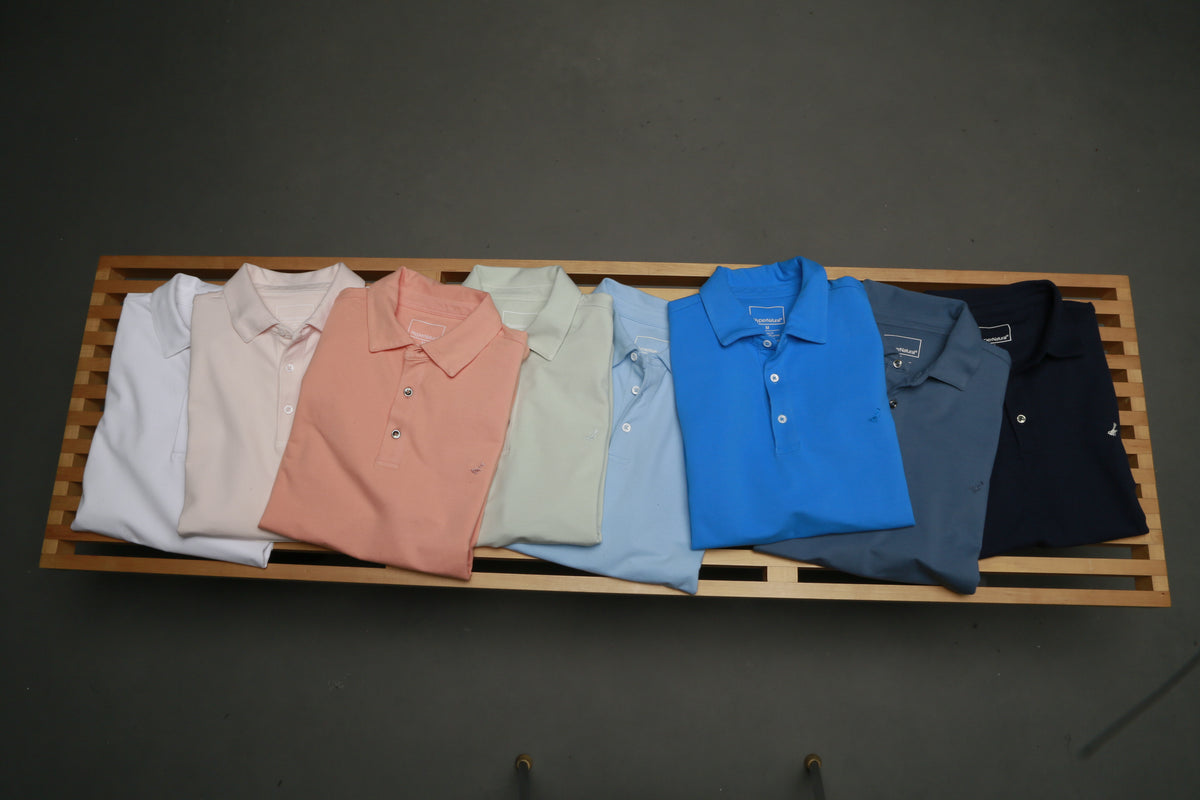
Two knits carry those ingredients onto the course. The Dagger is a slim-fit micro-pique: a textured, open surface that keeps the fabric off the skin and moves air, with Hyper-Cool Jade® and Hyper-Chitin in the fiber so it cools and stays fresh without a finish. The Pinehurst is a classic-fit featherweight jersey: smooth, light and built for the hottest days of the season, with the same Hyper-Cool Jade® and Hyper-Chitin in the fiber. Both are Supima® with Hyper-Cool Jade®, and both are 0% polyester.
Better for you
What is on your body is in your body. For four hours on a course a golf shirt is the largest thing touching your skin, and it is warm and damp for most of that time, which is exactly the condition under which finishes migrate and polyester's oily odor compounds accumulate. A plastic shirt should not be on your skin for that long. A polyester-free fabric removes the material that holds heat and odor in the first place. Every HyperNatural fabric is OEKO-TEX® Standard 100 certified, meaning the finished textile, dyes included, was tested against published limits for harmful substances, and our fabrics are produced under the bluesign® system, which screens the chemistry at the mill rather than at the end. The odor control is a natural antimicrobial instead of a metal finish, and the cooling is a mineral in the fiber instead of a coating. None of this makes a shirt medicine. It makes it a shirt with nothing in it you would not want against your skin all day, which is a low bar the polyester polo does not clear.
Better for the planet
0% polyester means the microfiber problem documented by Napper, Thompson and De Falco does not apply to the fiber that makes up the shirt: cellulose fibers shed too, but they biodegrade rather than persist. The recycled spandex is GRS certified; the packaging is FSC sourced. "Sustainable" is a word HyperNatural uses carefully, because cotton farming uses water and viscose production uses chemistry, and a natural fiber is a direction, not a free pass. The claim HyperNatural makes is specific: no petroleum fiber, no persistent plastic shedding, and third-party certification at each step where it exists. Polyester fails the first two by definition and rarely bothers with the third.
Which should you wear?
-
Hot and humid, heavy sweater: the Dagger micro-pique, Hyper-Chitin in the fiber for the sweat and Hyper-Cool Jade® for the heat. The open Supima® knit has less fabric to saturate and more surface to dry from, and Hyper-Cool Jade® keeps it cool against you. Avoid heavy commodity cotton, and avoid plastic.
-
Hot and dry: the Pinehurst featherweight jersey, Hyper-Cool Jade® and Hyper-Chitin included. Evaporation does the work and Hyper-Cool Jade® adds to it. Not polyester.
-
Cool, windy, chance of rain: a HyperNatural polo with a rain shell over it. Wet cotton on a cold day chills you, so keep the polo dry; the shell is the only place plastic belongs.
-
Midday sun: sunscreen first, then a dark, HyperNatural polo.
-
Course to clubhouse to dinner, or sensitive skin: any HyperNatural polo. It will smell fine, stay cool and look like a shirt. Polyester manages none of the three.
Frequently asked questions
Are cotton golf shirts bad for hot weather?
No. Cotton absorbs sweat and evaporates it from the fabric, which cools you in dry heat, and a controlled study found no difference in body temperature between cotton and wicking polyester during exercise at 30°C, so the polyester "cooling" polo has no edge. Cotton's failure mode is saturation: in humid heat, a heavy cotton knit can soak through and stay wet. A HyperNatural polo, lightweight Supima® pique or featherweight jersey with Hyper-Cool Jade® conducting heat off the skin, avoids most of that; a heavy commodity cotton jersey does not.
Does polyester really wick sweat better than cotton?
It wicks differently, not better. Polyester fibers absorb almost no water (about 0.4% standard regain versus 8.5% for cotton), so sweat travels along the plastic surface through the knit and evaporates from the outside; until it does, it is still on you. Cotton absorbs the sweat into the fiber first and pulls more moisture off the skin. Polyester's one point is that it never saturates, and HyperNatural answers it with the knit: a light Supima® micro-pique or featherweight jersey has less fabric to fill and more surface to dry from, with no plastic against your skin.
Why do polyester golf shirts smell after one round?
Because polyester holds odor, and both reasons are documented. Polyester hosts odor-producing Micrococcus bacteria that were found almost exclusively on synthetic shirts in a 2014 study of shirts worn for a spinning session. And a 2024 University of Alberta study found polyester absorbs the oily odor compounds in sweat rather than the water, then releases them slowly, so it holds odor intensity longer than cotton, viscose, wool or nylon. Cotton absorbed and released the least odor of the fibers tested. The fix is a fiber that does not hold odor in the first place, which is why HyperNatural builds on Supima® cotton and adds Hyper-Chitin, a natural antimicrobial from crab shells, for a 99%+ reduction in odor-causing bacteria.
Does a cotton golf shirt protect you from the sun?
Not much on its own, and UPF is the one number polyester's marketing has. A plain white cotton T-shirt rates about UPF 7, and about 3 when wet, according to the Skin Cancer Foundation. Polyester fabrics test higher: in a survey of 236 summer fabrics, more than 70% of polyester and wool samples rated UPF 30+ against fewer than 30% of cotton, linen and viscose. Darker colours and tighter knits raise any fabric's UPF substantially, so a navy cotton pique does far better than a thin white tee. For long midday rounds wear sunscreen under any shirt; it beats polyester's UPF without plastic, and a HyperNatural polo gives you a cool, breathable, certified fabric underneath it.
What is the best fabric for a golf shirt?
Not polyester. It is the cheapest fiber to make and print, not the best one to wear: it holds heat and odor and sheds microfibers, and what it offers back, faster rack drying, a UPF number, no creasing and a low price, is trivial on the course or the brand's benefit rather than yours. Cotton beats it on odor, fiber-level breathability, feel and the absence of microplastics. The best fabric is HyperNatural's third path: Supima® cotton engineered with Hyper-Cool Jade® and Hyper-Chitin, which keeps cotton's advantages and fixes heat and odor in the fiber itself: 20× more breathable than polyester, 5° cooler on skin, 99%+ fewer odor-causing bacteria, OEKO-TEX® Standard 100 certified and 0% polyester.
What does "better by nature" mean for a golf shirt?
It means the performance comes from engineering a natural fiber rather than from petroleum or a chemical finish. HyperNatural embeds jade minerals in a cellulose fiber for cooling, uses chitin from crab shells as a natural antimicrobial for odor, builds on extra-long-staple Supima® cotton for strength, and adds GRS-certified recycled spandex for recovery. The result is a shirt with no polyester to hold heat, hold odor or shed plastic, tested to OEKO-TEX® Standard 100 and produced under the bluesign® system: better for the wearer and better for the planet. A pure synthetic still dries a few minutes faster on the rack and midday sun still needs sunscreen, like any cotton; that is not worth wearing plastic for.
Sources
- ASTM D1909, Standard Table of Commercial Moisture Regains and Commercial Allowances for Textile Fibers: cotton 8.5%, polyester 0.4%.
- Jerkovic et al. (2025), "Drying Performance of Fabrics on the Human Body," Materials (Basel), Empa. pmc.ncbi.nlm.nih.gov/articles/PMC12155929
- Gavin et al. (2001), "Clothing fabric does not affect thermoregulation during exercise in moderate heat," Medicine & Science in Sports & Exercise 33(12). pubmed.ncbi.nlm.nih.gov/11740309
- Bakkevig & Nielsen (1994), "Impact of wet underwear on thermoregulatory responses and thermal comfort in the cold," Ergonomics 37(8). tandfonline.com/doi/abs/10.1080/00140139408964916
- Stanković et al. (2013), "Transient thermal response of textile fabrics made of natural and regenerated cellulose fibers," Polymer Testing. sciencedirect.com/science/article/abs/pii/S0142941813002523
- Callewaert et al. (2014), "Microbial Odor Profile of Polyester and Cotton Clothes after a Fitness Session," Applied and Environmental Microbiology 80(21). journals.asm.org/doi/10.1128/aem.01422-14
- McQueen et al. (2024), "Textile sorption and release of odorous volatile organic compounds from a synthetic sweat solution," Textile Research Journal, University of Alberta / University of Otago. journals.sagepub.com/doi/10.1177/00405175241249462; summary at phys.org
- Ke et al. (2021), "Antimicrobial actions and applications of chitosan," Polymers 13(6):904. pmc.ncbi.nlm.nih.gov/articles/PMC8303267
- Egorov et al. (2023), "Chitosan and its derivatives: preparation and antibacterial properties," Materials 16(18):6076. pmc.ncbi.nlm.nih.gov/articles/PMC10532898
- The Skin Cancer Foundation, "Sun Protective Clothing": white T-shirt UPF ~7, ~3 wet. skincancer.org
- Gambichler et al. (2001), "Protection against ultraviolet radiation by commercial summer clothing: need for standardised testing and labelling," BMC Dermatology 1:6. link.springer.com/article/10.1186/1471-5945-1-6
- Supima, "The Cotton": extra-long staple, about twice as strong as regular cotton, top 1% of world cotton. supima.com/the-cotton
- Golf Digest, "What's your shirt made of? It's time you actually found out." golfdigest.com
- C&EN (2013), "What's that stuff? Wrinkle-Free Cotton": hydrogen bonding and crosslinking finishes. cen.acs.org/articles/91/i48/Wrinkle-Free-Cotton.html
- Napper & Thompson (2016), "Release of synthetic microplastic plastic fibres from domestic washing machines," Marine Pollution Bulletin 112. researchgate.net/publication/308736592
- De Falco et al. (2020), "Microfiber Release to Water, Via Laundering, and to Air, via Everyday Use," Environmental Science & Technology 54(6). pubmed.ncbi.nlm.nih.gov/32101431
- Textile Exchange, Materials Market Report 2025: 132 Mt fiber in 2024; polyester 59%, 88% fossil-based; cotton 19%. textileexchange.org
- Textile Exchange, Global Recycled Standard. textileexchange.org/global-recycled-standard
- bluesign® system: chemical input screening at the mill. bluesign.com
- OEKO-TEX® Standard 100: testing of finished textiles for harmful substances. oeko-tex.com
- Fibre2Fashion, "Cotton vs Polyester: Cost Reality Check": polyester yarn $2.04/kg vs cotton $3.12/kg, week ending 10 Nov 2024. fibre2fashion.com
- MyGolfSpy, "The Five Best Cotton Golf Polos." mygolfspy.com
- GolfWRX forums, "Anybody Else Not Like Polyester Golf Shirts" and "Cotton vs Dri fit shirts": golfer reports on odor and feel. forums.golfwrx.com